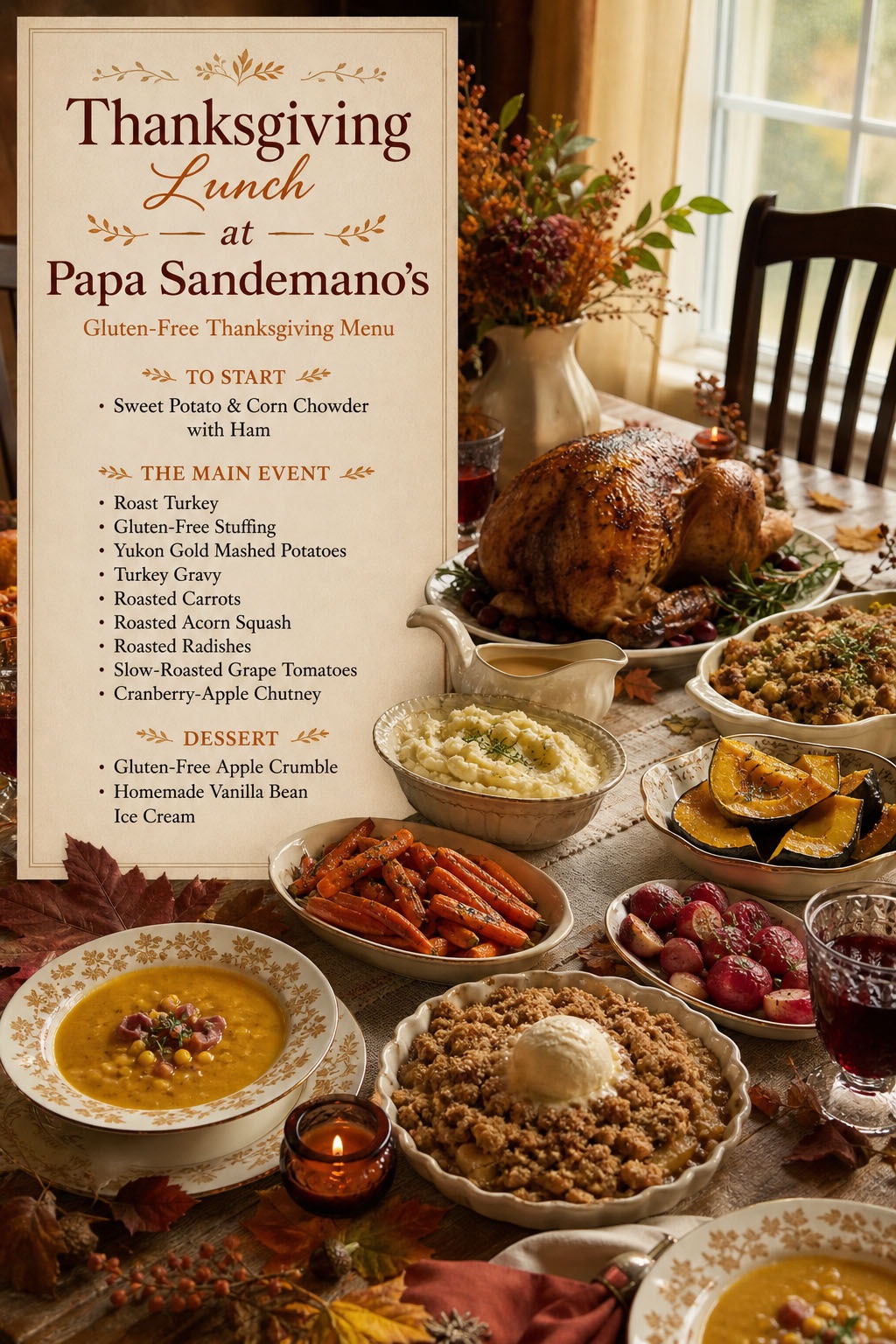
Individual gluten-free apple crumbles, finished with homemade vanilla bean ice cream. (I’ve promised Mrs Sandemano that we will not recreate the Smarties Ice Cream.)
The entire menu is gluten-free, because everyone deserves to enjoy Thanksgiving without having to worry about what’s on their plate.
Today is all about the mise en place. Tomorrow, we’ll see whether all this planning actually pays off.
The other day, I got the annual email reminding me to check all the information about my website.
So I did my due diligence and skimmed through the details. Really, nothing has changed over the past twenty years except the host, but one line of data smacked me in the face:
Holy shit, has it been twenty years?
Twenty years of posts, experiments, abandoned ideas, and I’ll admit, a stupendous pile of drafts yelling, “Post me!” or “Finish me!” or, occasionally, “Why did you put me back into drafts???!?”
And while it definitely hasn’t made me the millions I hoped would roll in when I first started, it turns out it was never really about that. It was for me.
So, if you’ve stopped by, welcome to Papa Sandemano’s.
Batch #1 came out technically pickle-shaped, technically fermented, and pretty fucking insipid. I threw some apple cider vinegar into the jar in an attempt to rescue them and gave the whole experiment about a 5/10.
Naturally, my response was:
Okay. Let’s do this again.
~Papa Sandemano
But before Batch #2, I went looking to see how other people were doing this.
I pulled out Joshua Weissman’s An Unapologetic Cookbook and looked at his recipe for lacto-fermented vegetables. I wasn’t really looking for another recipe to copy. I wanted to see what he was doing differently—and whether that might explain why Batch #1 had been so fucking insipid.
Then I worked through it with ChatGPT using my own notes from Batch #1, comparing what I’d done, what Weissman was doing, and what I actually wanted to change. Between the book, my notes, and a lot of back-and-forth, I came up with a process for Batch #2 that made sense to me.
Or at least, that was the plan.
A few weeks later, I finally got around to it.
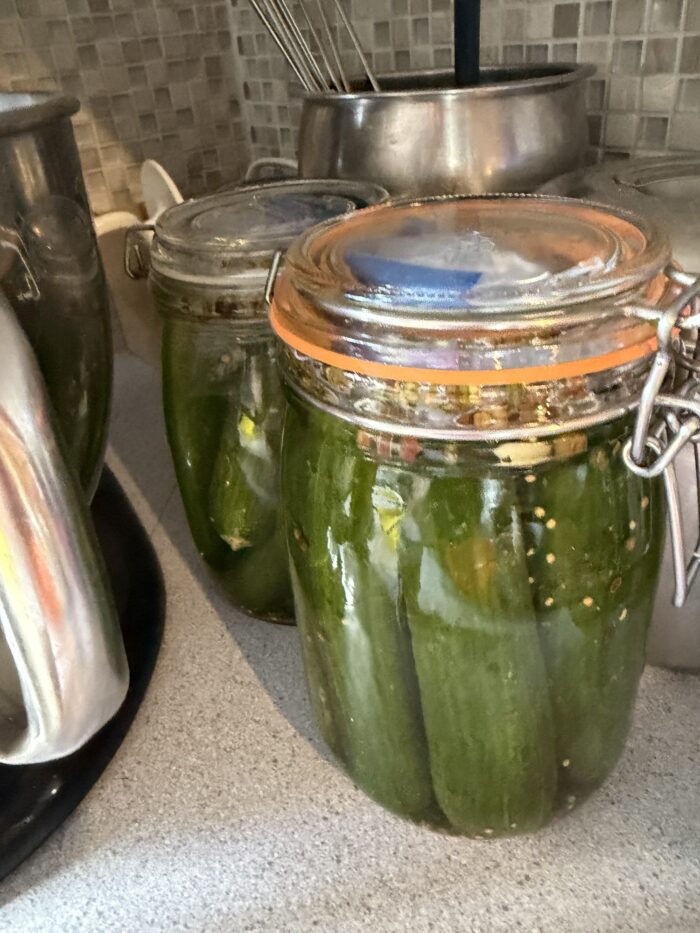
I had another batch of Costco cucumbers (less than three bucks—a steal), and while I was hunting for 1-litre jars big enough for my pickle pipes, I stumbled across these cool fucking flip-top jars I’d been wanting to try, and to prove to Mrs. Sandemano that there was a point to owning so many of these.
I figured, why not? The pickles fit. It’s got a seal, they’re easier to burp, and it’s less hassle. Right?
Cool. Rock on.
So I started loading everything in. Measured the spices, added the garlic, packed in the cucumbers and filled the jar with water.
Which is when I realized I’d designed myself a pretty fucking stupid process.
I needed the weight of the water so I could calculate the salt for the brine. Which meant I now had to pour the water back out of a jar I’d already filled with dill, coriander seeds, garlic and cucumbers.
Fine. Strain it, weigh the water, calculate the salt, whisk it together and pour the brine back in.
Except I was making two jars.
And on the second one, I forgot the fucking strainer.
So now I’m standing there whisking salt into a bowl of water with dill and coriander seeds swimming around in it, thinking:
There has got to be a less stupid way to do this. ~every time a good cook learns how to do a new task
And there is.
I could have just weighed the fucking spices and garlic first, accounted for that weight, and saved myself this entire exercise.
Lesson learned.
Anyway. Brine made. Pickles packed.
Then the fucking cucumbers (and spices) started floating.
Fuck!
I hadn’t thought about that.
The cucumbers wanted to come up. The dill and coriander seeds wanted to come up. And I suddenly realized that these cool fucking flip-top jars had one fairly significant disadvantage:
I had absolutely nothing to keep this shit under the brine.
So now I’m troubleshooting live. I remembered reading that you could use a Ziploc bag filled with brine as an improvised fermentation weight. Fine. I’ve got Ziploc bags. I figured that Gemini could give me the quick low-down.
After a ten-minute dive into a rabbit hole, I came out the other end with indeed—you could use Ziploc bags as an impromptu fermentation weight—the caveat is you need to ensure there’s fresh brine inside as the weight. (This way, if the bag breaks you’re safe.)
Easy. In goes the bag.
Cucumbers down. Spices mostly down. A massive pain-in-the-ass to close, brine everywhere.
Fuck it! Good enough! Problem solved.~ Papa Sandemano
Or, as it turns out, problem relocated.
A couple of days later, I noticed the jars were leaking brine.
Every time I messed with the lids, I seemed to lose a little more, so eventually I put the jars on a pizza pan, covered the whole thing with a towel and left the lids open rather than constantly burping them.
Then I left them alone to ferment.
On Day 5, I came back to check them.
Jar #1 looked pretty much like I’d left it.
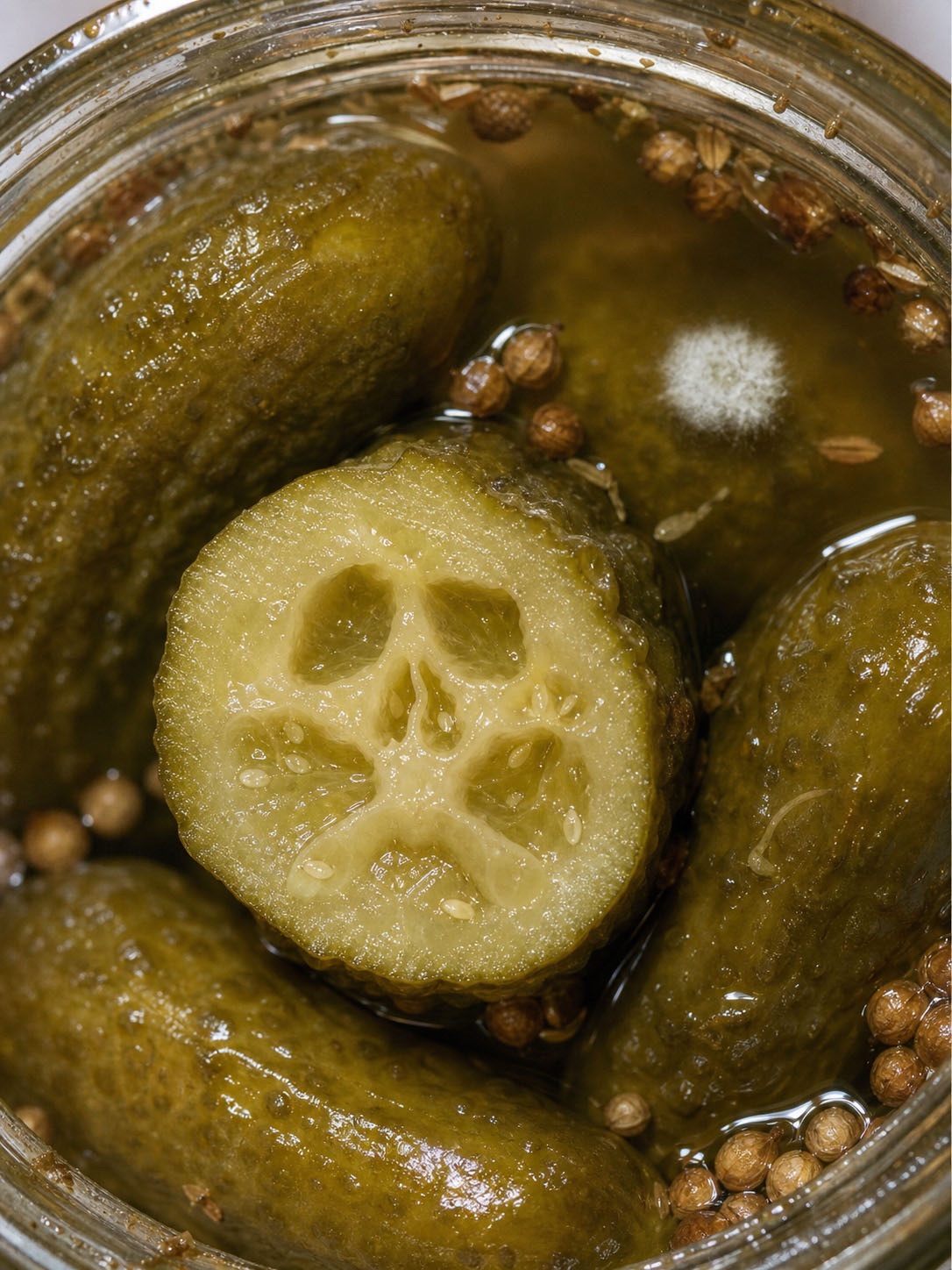
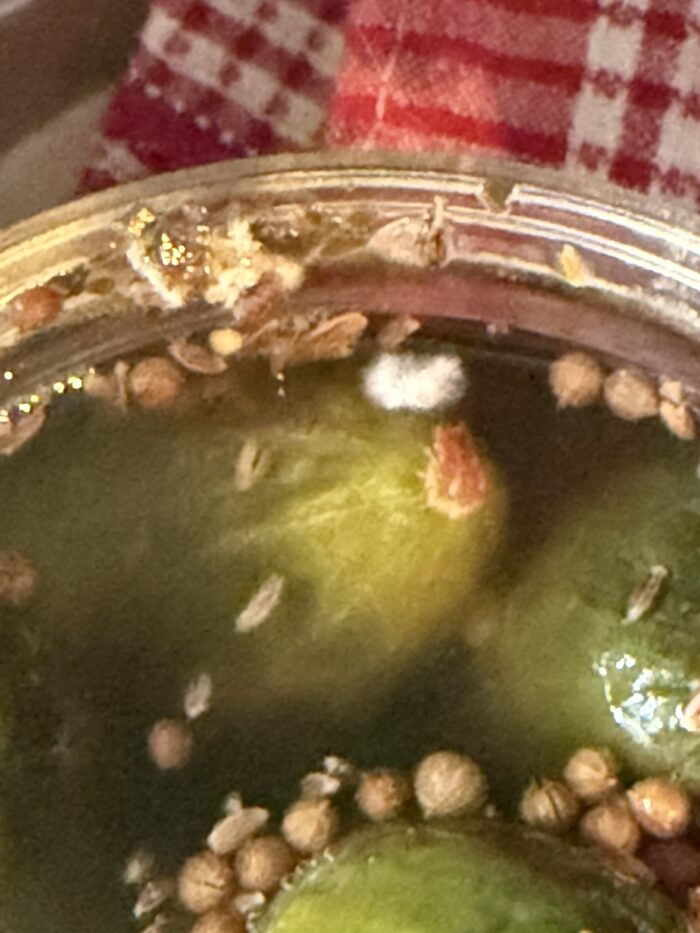
Jar #2 did not. When I opened the lid, my brain saw (with a little imaginative help from Firefly)
Sometimes the experiment answers the question you forgot to ask.
Uh oh.
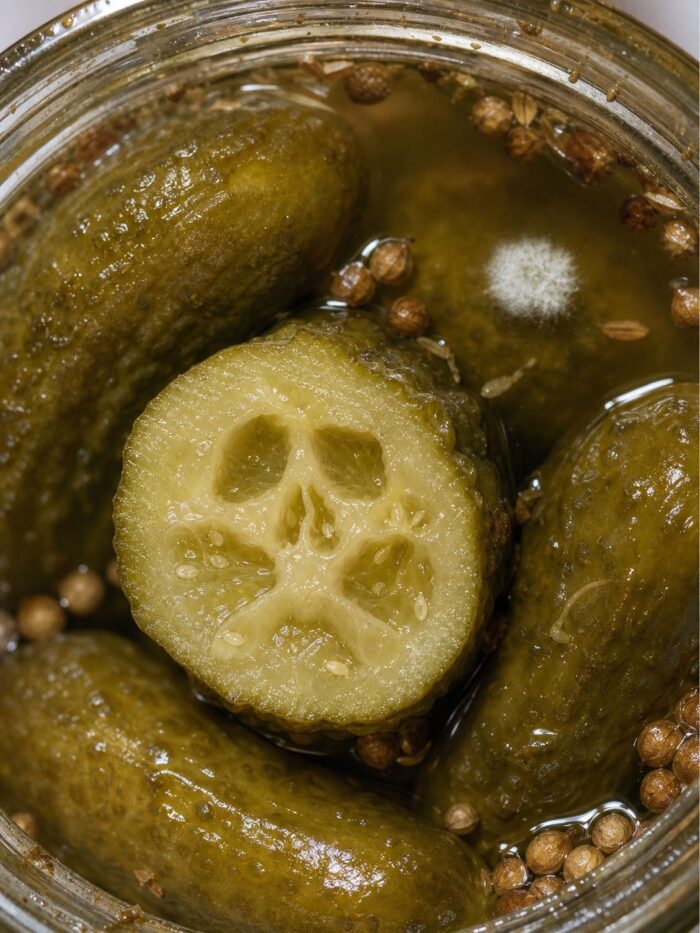
There, sitting right at the surface amongst the floating spices, was a nice little fuzzy white patch. This is what I really saw :
Mold. So much for “problem solved.” ~ Papa Sandemano
Well, fuck.
Jar #2 was done. I’m adventurous, not stupid. That one was going in the bin.
Jar #1 didn’t have the same fuzzy patch, so I dealt with the frothy shit floating at the surface, got everything submerged again and decided to see where it goes. This time I was taking no chances, and seeing if the ramekin I’m using as a weight will work out.
Which left me wondering what the fuck had actually gone wrong. Too many variables at once?
And then, because apparently the universe has a sense of humour, I went downstairs.
So, I’m putting stuff away and finally decide it’s time to throw out the Mutti bottles I’d been saving for passata. (Fuck it. I’ll use Mason jars.)
And sitting there was a neatly tied plastic bag. Guess what’s inside?
Two 1-litre wide-mouth Mason jars.
For those of you saying (rightly) “You have got to be fucking kidding me…” in my defense, I forgot that before we left for vacation back in June, my mother-in-law had sent these home with Mrs. Sandemano for me. I’d put them downstairs because I already had all those Mutti bottles and figured I probably wouldn’t need them.
These were the exact fucking jars I’d been looking for when I started Batch #2. The ones that fit the pickle pipes I already own.
Of course they were sitting in my basement the whole fucking time.
So, yeah. There will be a Batch #3.
Same experiment. Fewer variables.
One-litre wide-mouth Mason jars. Pickle pipes.
As for Jar #1 of Batch #2? As the French say—À venir!
Fifteen years ago, I wasn’t “Papa” yet. I was just a sous chef—young, eager, and utterly convinced that more was always better:
✅ More ingredients.
✅ More sauce.
✅ More flair.
And then there was Chef.
We called him Maurice, but he’ll always just be Chef to me. You could be knee-deep in the weeds—thirty tickets in, the line on fire—and Chef would waltz in, put down his cocktail, tie on his black apron over a perfectly pressed chef jacket, and calmly get to work. Within minutes, chaos became calm. It was maddening to work with him, but the man was a master, and you couldn’t help but learn.
One night, Chef turned to me and said, “Make me a stir-fry.”
It seemed simple enough. Stir-fry is easy, right? Just throw a bunch of stuff into a pan, douse it in sauce, and voilà! So that’s exactly what I did. I grabbed every vegetable I could find:
✅ carrots
✅ celery
✅ onions
✅ mushrooms
✅ bell peppers
✅ bean sprouts
✅ choi tips.
Then came the sauces:
✅ soy
✅ teriyaki
✅ oyster
✅ sambal
✅ sesame oil
✅ hell, I might’ve added plum sauce just for kicks.
It was a kaleidoscope of flavors and colors, a masterpiece (or so I thought).
I plated it up and handed it to Chef. He took the dish with his signature aloofness, gingerly used his fork to lift a small amount to his mouth, and tasted it.
He sighed.
Then, without a word, he handed the dish back to me.
That maddening smile spread across his face as he stood there. I was dumbfounded.
“What the fuck, Chef?” I asked.
He grinned and, with that signature look—half smirk, half mystery—said, “It tasted very…Canadian. Good job. It’s like what you’d cook at a Chinese buffet in the Prairies.”
Ouch.
“Too much going on,” he continued. “Onions, garlic, soy, sambal, teriyaki, six kinds of vegetables—why? You’re stacking flavors like it’s a lasagna. Keep it simple. Respect the ingredients. They taste good—why are you trying to hide them?”
That moment was a gut punch—but also a revelation.
Chef taught Papa something he’ll never forget: simplicity isn’t boring—it’s bold. Sometimes, the simplest solutions are the best. Take that VH Sweet-and-Sour Sauce, for example. There’s no shame in using it. Chef would say, “It’s not like all Asians make their own soy sauce.” Sure, you can make your own sauce if you’ve got time, but why get cute about it when the jarred stuff gets the job done?
Years later, that lesson came full circle with today’s recipe. It’s the anti-buffet stir-fry: crisp tri-colored peppers, red onion, just enough sweet-and-sour sauce to moisten, and a handful of chili-lime peanuts for a kick. That’s it. Simple, clean, and damn good.
The Recipe
Fine! Here’s the recipe! Sometimes Papa gets distracted. Thanks for sticking with Papa.
Peppers with Sweet-and-Sour Sauce and Chili Peanuts
Total Time: ~10 minutes | Serves: 2-4
Ingredients
1 fl oz vegetable oil
1 small red onion, medium dice (1 cm)
1 small red pepper, medium dice (1 cm)
1 small yellow pepper, medium dice (1 cm)
1 small green pepper, medium dice (1 cm)
1/2 fl oz Shaoxing wine (or eyeball it—you’re not auditioning for Top Chef)
2 fl oz VH Sweet-and-Sour Sauce
A handful of lime-and-chili-flavored peanuts
Method
Heat the Oil: Heat the vegetable oil over medium-high heat in a wok until shimmering.
Start with Onions: Add the diced red onion and cook for 1 minute, just until they soften.
Add the Peppers: Toss in the diced peppers. Stir-fry for another 1 minute, keeping them crisp.
Deglaze with Shaoxing Wine: Sprinkle the Shaoxing wine over the vegetables and let it cook off. This step builds the flavor—don’t skip it!
Sauce It Up: Add the VH Sweet-and-Sour Sauce. Stir and bring it to a gentle simmer. Lower the heat and let it cook for another minute.
Add the Peanuts: Remove the wok from heat and toss in a handful of peanuts for crunch and a little zing.
Taste and Adjust: Taste the dish. Adjust with salt and pepper if needed (though it might already be perfect).
Papa’s Notes
Quick and Crisp: The short cooking time keeps the veggies vibrant. If they’re mushy, you’ve gone too far.
Peanuts are the MVP: I used kettle-cooked lime-and-chili peanuts (Compliments brand). If you can’t find them, use plain roasted peanuts with a squeeze of lime and a pinch of chili powder.
Papa Wanna Get Something Off Papa’s Chest
“Hey Papa–what’s the deal? You’re using VH sauce? I thought you were a chef?” – A smart-ass apprentice, probably
No Sauce Shame: VH Sweet-and-Sour Sauce is the real deal when you’re short on time or just need something simple. Chef Maurice once told me, “It’s not like all Asians make their own soy sauce.” Convenience doesn’t equal compromise—it’s about using the right tool for the job.
Make It Your Own Later: If you want to make your own sauce, we can tackle that another day. But for now? Crack open that jar and let it do the heavy lifting.
Don’t have Shaoxing wine and can’ use it as an excuse for an Asian-Market excursion? Don’t sweat it, sherry (or even white wine) will do here-the alcohol is what promotes the flavour.
Optional Add-Ons
Papa knows it can be tempting to add more to this, so that it can shine better, right? Keep it simple, and don’t complicate the flavors. The only thing Papa might do to bring a little extra flair would be to garnish with thinly sliced Asian-Style scallions.
Have you tried this recipe? Share your thoughts or variations in the comments below! And don’t forget to subscribe for more Papa Sandemano recipes and lessons.